


Introducing Animal Acupressure Academy
Professional online education + in-person hands-on training for practitioners who want to understand the animal through meridians, anatomy, touch, assessment, and whole-body clinical reasoning.
Industry leading professional certification pathway for Acupressure in Equine or Small Animal. Providing a 200+ hour online program with 50 hour in person pathway to make practitioners eligble for Board Certification with NBCAAM & IAHAP.
One of the Most Comprehensive Animal Acupressure Certification Pathways Available
The New Standard in Professional Animal Acupressure Education
This is not simply an acupressure course.
This is a complete professional training pathway for practitioners who want to study animal acupressure with depth, structure, hands-on refinement, and real-world application.
The Animal Acupressure Academy combines Traditional Chinese Medicine principles, Western anatomy, meridian theory, point location, clinical reasoning, live demonstrations, high-quality visual charts, interactive assignments, case study development, business training, and a comprehensive in-person intensive into one of the most complete animal acupressure certification pathways available.
With over 250 online lessons and a 5-day in-person intensive taught by a practicing acupressurist with 30+ years of experience, this Academy was designed for students who want more than a surface-level certification.
It was built for serious practitioners who want to understand the animal as a connected system - and who want the confidence, skill, and professional foundation to apply acupressure safely, ethically, and effectively with horses, dogs, and cats.
Students do not simply memorize points.
They learn how to assess the animal, understand meridian and tissue patterns, recognize emotional and nervous system responses, build thoughtful protocols, document professionally, communicate with clients, and create a successful acupressure service within their practice.
This is where online education, hands-on training, clinical reasoning, and professional development come together.
This is the Animal Acupressure Academy.
What Is Animal Acupressure?
Animal acupressure is a non-invasive modality rooted in Traditional Chinese Medicine that uses intentional pressure on specific acupoints to support balance within the body.
These acupoints are found along meridian pathways, which are traditionally understood as energetic communication pathways connected to body systems, organ relationships, emotional patterns, tissue quality, and whole-body function.
In practice, acupressure is not about randomly pressing points or following the same routine for every animal.
A skilled acupressure practitioner learns to observe the animal, assess patterns, palpate tissue, recognize sensitivity, understand meridian relationships, and choose points with intention.
Acupressure may be used to support relaxation, emotional balance, mobility, recovery, digestive wellness, senior animal comfort, performance support, and whole-animal regulation - while always remaining within proper scope of practice and never replacing veterinary care.
What a Professional Acupressure Program Should Include
A true professional training program should be built on depth, structure, and accountability. Professional-level training should go beyond isolated point memorization and prepare practitioners to understand why points are chosen, how they interact within the body, and when acupressure is appropriate within a broader care framework.
That is exactly why the Animal Acupressure Academy was designed as a complete certification pathway.
1. A Comprehensive Curriculum
A professional acupressure program should include more than introductory theory or a list of commonly used points.
The Animal Acupressure Academy includes over 250 online lessons covering the foundations of acupressure, Traditional Chinese Medicine theory, Western anatomy, meridian pathways, acupoint location, point categories, assessment, deficiency and excess patterns, Five Element theory, emotional balance, nervous system regulation, protocol development, integrative modalities, case study reasoning, documentation, ethics, client communication, and business development.
Students study the work from foundation to professional application.
They are not expected to piece together their education from multiple disconnected courses. The Academy brings the full picture together in one structured pathway.
2. Anatomy and Body Systems Education
Professional acupressure training should include anatomical education as a foundation, not an optional extra. A professional practitioner needs to understand skeletal landmarks, joint relationships, muscle groups, myofascial lines, neurological relevance, and organ locations so acupressure can be applied with precision and safety.
Inside the Academy, students study anatomy through an acupressure lens.
This includes surface anatomy, bony landmarks, major muscle groups, fascia, tendons, ligaments, major joints, spinal regions, nervous system relevance, lymphatic and circulatory considerations, organ regions, and safety around sensitive structures.
This matters because accurate point location depends on understanding the body under your hands.
3. Traditional Chinese Medicine Foundations
A strong acupressure education must include Traditional Chinese Medicine foundations, not just point recipes.
Students in the Animal Acupressure Academy study Qi, Blood, Jing, Shen, Yin, Yang, Five Element theory, Zang-Fu organ relationships, meridian flow, constitutional patterns, seasonal influences, deficiency, excess, heat, cold, dampness, stagnation, and root versus branch treatment.
This helps students move beyond symptom-based thinking.
Instead of asking, “What point do I use for this problem?” students learn to ask, “What pattern is this animal showing me, and how do I support the body with intention?”
4. Meridian and Acupoint Study
Professional programs should teach meridians as complete pathways, not isolated points. Students need to understand how meridians relate to each other and how point categories influence strategy.
The Academy includes detailed study of the 12 primary meridians, the Governing Vessel, and the Conception Vessel.
Students learn:
-
meridian pathways
-
Yin and Yang relationships
-
paired meridians
-
direction of flow
-
meridian tracing
-
key landmarks
-
major acupoints
-
point locations
-
point functions
-
signs of imbalance
-
common pairings
-
cautions
-
simple protocols
-
practitioner-level protocols
Students also study important point categories, including source points, Luo-connecting points, Xi-cleft points, Jing-well/Ting points, He-sea points, command points, influential points, master points, alarm points, and Back Shu points.
This teaches students how to choose points with purpose.
5. The Most High-Quality Charts Available
Visual learning matters in acupressure.
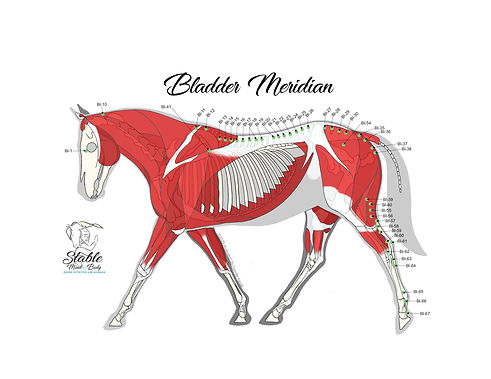
That is why Animal Acupressure Academy includes some of the highest-quality animal acupressure charts available, created to help students understand meridian pathways, point locations, anatomical landmarks, and the relationship between points and the body.
These charts are designed to support both visual learning and real-world practice.
Students are not left trying to translate vague diagrams into practical point location. They are given clear, professional, detailed visual resources to support their learning throughout the course and beyond.
6. Live Demonstration Videos
Charts are important, but acupressure cannot be learned from diagrams alone.
Professional training should include live animal demonstrations, because students need to see how animals respond to palpation, pressure, subtle touch, tissue changes, and energetic shifts. Video demonstrations and in-person work provide context that static images cannot.
The Academy includes live demonstration videos to help students see the work in action.
Students are guided through point location, meridian tracing, pressure application, practitioner positioning, animal response, signs of release, signs of stress, and how to adjust the session based on the individual animal.
This is essential because real animals are not diagrams.
They move, react, guard, soften, shift, brace, communicate, and respond.
The demonstrations help students connect theory to practice.
7. Assessment and Clinical Reasoning
Professional acupressure is not about applying the same points to every animal.
Students need to learn how to assess before selecting points. Assessment may include observation, palpation, behavioural presentation, emotional state, posture, movement, tissue quality, and energetic patterns related to meridians and organ systems.
Inside the Academy, students learn intake interpretation, owner questions, observation before touch, posture and stance, facial expression, emotional state, coat and skin clues, hoof and limb clues, muscle tone, temperature changes, tissue texture, meridian palpation, acupoint reactivity, alarm point assessment, Back Shu point assessment, and reassessment after treatment.
This is where the program becomes much more than point location.
Students learn how to think through what the animal is showing them.
8. Case-Based Learning and Documentation
Case studies are one of the most important parts of professional certification. They help students document assessments, explain point selection, track outcomes, and develop accountability in their work.
The Animal Acupressure Academy includes extensive written and video homework assignments, case study development, SOAP-style documentation, client communication practice, and professional reflection.
Students are asked to show not only what they did, but why they did it.
That is what helps turn information into practitioner skill.
9. Hands-On In-Person Training
Acupressure is a tactile practice.
Professional education should include guided practice, observation, repetition, palpation, pressure adjustment, and feedback. Hands-on skill development is essential for reading tissue changes, recognizing animal responses, and adjusting technique appropriately.
The Animal Acupressure Academy includes a comprehensive 5-day in-person intensive where students integrate what they have learned online into real hands-on practice.
Students are eligible to attend the in-person clinic once they reach the required point in the online coursework.
This allows students to arrive with a foundation already in place, so the clinic can focus on refinement, application, confidence, feedback, and practical integration.
10. Professional Standards, Scope, and Business Development
Professional acupressure training should include ethics, scope of practice, veterinary referral, client communication, informed consent, and record keeping. These standards protect the animal, the client, and the practitioner.
The Academy also goes further by teaching students how to build acupressure into a real professional practice.
Students learn documentation, SOAP notes, intake forms, consent forms, contraindication informed consent, client communication, legal and ethical considerations, pricing, packages, service menus, marketing, clinic development, demos, referral relationships, and how to explain acupressure professionally without making medical claims.
Because certification should not leave students wondering, “Now what?”
It should help them step forward with confidence.
The Animal Acupressure Academy Certification Pathway
The Academy gives students a clear step-by-step pathway from coursework to certification to board examination eligibility. Step 1: Complete the Online Coursework Students begin with the online curriculum, which includes over 250 lessons covering foundational theory, anatomy, meridian education, point location, assessment, protocol development, clinical reasoning, documentation, ethics, business, and species-specific application. Each module includes quizzes to support retention and accountability. Step 2: Complete Video and Written Homework Assignments Throughout the course, students complete written and video homework assignments designed to help them apply what they are learning. These assignments help students practice point location, meridian tracing, assessment, protocol building, professional reasoning, and documentation. Step 3: Complete Required Case Studies Students complete a detailed case study portfolio, including: 5 written case studies 2 multi-session case studies 3 video case studies These case studies help students demonstrate their ability to assess the animal, select points with intention, document professionally, observe responses, and adapt the session when needed. Step 4: Complete the Self-Reflection Assignment Students complete a self-reflection assignment to evaluate their growth, confidence, practitioner presence, areas of strength, and areas needing continued development. This helps students become more aware, intentional, and professional in their work. Step 5: Complete Module Quizzes and Final Exam Students complete quizzes after each module and a final 75-question exam. This ensures students are not simply moving through the content, but actively learning and retaining the material. Step 6: Attend the 5-Day In-Person Intensive Once students reach the required point in the online course, they may attend the 5-day in-person clinic. This intensive allows students to integrate the online material through guided hands-on practice, live animal work, point location refinement, meridian tracing, pressure application, assessment, and practitioner feedback. Step 7: Submit Final Requirements Students submit their homework assignments, case studies, exam, and in-person clinic completion requirements for review. Once all requirements are successfully completed, students receive certification through the Animal Acupressure Academy pathway. Step 8: Become Eligible for the IAHAP Board Examination The Animal Acupressure Academy program is accredited and approved with the International Association of Holistic Animal Practitioners. Because of this approval, once students complete the program requirements, there is no additional board application process through IAHAP. Students are eligible to move directly into the IAHAP Board Examination. Step 9: NBCAAM Board Exam Direction Animal Acupressure Academy is also currently in application for NBCAAM certification recognition. Once approved, students may also be able to sit for the NBCAAM Acupressure Board Exam, creating an additional professional credentialing pathway for graduates.
What You Will Study Inside the Academy
Foundations of Animal Acupressure What acupressure is, acupressure vs acupuncture, scope of practice, professional boundaries, working alongside veterinarians, course expectations, case study requirements, and certification pathway. Traditional Chinese Medicine Theory Qi, Blood, Jing, Shen, Yin, Yang, meridian theory, Five Element theory, Zang-Fu organ relationships, constitutional patterns, seasonal influences, and the body as a connected system. Anatomy for Acupressure Species-specific surface anatomy, bony landmarks, major muscle groups, fascia, tendons, ligaments, joints, spinal regions, nervous system relevance, organ regions, and safety around sensitive structures. Meridian and Acupoint Training The 12 primary meridians, Governing Vessel, Conception Vessel, point locations, point functions, pathway tracing, acupoint categories, source points, Luo points, Xi-cleft points, Ting points, He-sea points, command points, master points, alarm points, and Back Shu points. Assessment and Pattern Recognition Intake, observation, palpation, emotional state, tissue tone, heat, cold, sensitivity, restriction, acupoint reactivity, alarm point assessment, Back Shu assessment, deficiency, excess, Yin, Yang, Qi, Blood, heat, cold, dampness, stagnation, and Five Element typing. Clinical Application and Protocol Development Musculoskeletal support, digestive and internal wellness support, emotional balance, nervous system regulation, senior animal support, performance support, mobility support, species-specific protocol building, case study reasoning, and multi-session progression plans. Integrative Acupressure Tools Laser acupuncture, photopuncture, acu-cupping, essential oils and acupoints, kinesiology taping for meridian support, moxibustion, and how to layer modalities safely without overstimulating the animal. Professional Practice and Business Development SOAP notes, intake forms, consent forms, documentation, client communication, legal and ethical considerations, pricing, packages, service menus, marketing, clinics, demos, referral relationships, and building a professional acupressure practice.


Why Animal Acupressure Academy Is the Clear Choice
Choosing an acupressure program matters.
You are not just choosing where to get a certificate.
You are choosing the education that will shape how you assess animals, how you touch them, how you communicate with clients, how you make professional decisions, and how confident you feel offering acupressure as a service.
Animal Acupressure Academy gives students a complete pathway instead of a partial education.
You receive:
-
over 250 online lessons
-
species-specific equine and small animal education
-
live demonstration videos
-
the most high-quality acupressure charts available
-
in-depth Traditional Chinese Medicine theory
-
Western anatomy and body systems education
-
assessment and clinical reasoning training
-
protocol-building support
-
written and video homework assignments
-
extensive case study requirements
-
quizzes after each module
-
a 75-question final exam
-
a 5-day in-person intensive
-
business and documentation training
-
IAHAP Board Examination eligibility
-
NBCAAM application pathway in progress
-
Lifetime access to course materials & updates
This is not a shortcut.
This is a professional academy-style certification pathway for students who want to become skilled, thoughtful, ethical, and confident animal acupressure practitioners.
A Bigger Curriculum for a Bigger Purpose
Animal acupressure deserves to be taught with depth.
The animals we work with are complex. Their bodies hold physical patterns, emotional patterns, compensation patterns, nervous system responses, energetic imbalances, and species-specific needs.
A short course can introduce acupressure. But a complete certification pathway should prepare you to think, assess, adapt, document, and practice professionally.
That is why the Animal Acupressure Academy is intentionally comprehensive.
It was created for students who want to take this work seriously, support animals with skill and respect, and build a professional practice rooted in knowledge, confidence, and whole-animal understanding.
If you are ready for more than a surface-level certification, this is where your training begins.
Best Value
Instant access
Laser AcuTorch & Laminated Meridian Charts
$445 Bonus
Save up to $1300
CAD $2095
Payment Plan Options
$650 x 4 Months
$500 x 6 Months
$400 x 8 Months
$275 x 12 Months